Champagne France Facts: 1.2 kg of Grapes a Bottle, 110 km of Cellars and a Myth
The short answer. Every figure here comes from the Comité Champagne, UNESCO or the houses themselves. A bottle takes about 1.2 kg of grapes and holds five to six bar of pressure. Some 110 km of cellars run under a 1.5 km avenue in Épernay. And nobody invented it: the region learned to master a second fermentation, and Dom Pérignon ran an abbey's estate.
The figures at a glance
| Figure | What it measures | Source |
|---|---|---|
| 1.2 kg | Grapes in one bottle | Comité Champagne |
| 5 to 6 bar | Pressure inside the bottle | Comité Champagne |
| 110 km | Cellars under the Avenue de Champagne | Comité Champagne |
| 16,460 | Growers, against 410 houses | Comité Champagne, 2025 |
| 266.1 million | Bottles shipped in 2025 | Comité Champagne, 2025 |
| 33 | Kings crowned at Reims | The cathedral parish |
1. A bottle holds 1.2 kg of grapes
That is the weight the Comité Champagne gives for one 75 cl bottle. Pour it out and it fills about six flutes of 12.5 cl. The grapes are picked by hand, because the rules require whole bunches at the press, and nearly 120,000 seasonal pickers come in every harvest to do it.
2. Nobody invented it
You will hear the Dom Pérignon story on every tour, and the Comité Champagne's own answer is short: champagne was not invented by anyone. The region was the first to try to understand and control the second fermentation that puts the bubbles in the bottle. Dom Pérignon ran the Hautvillers abbey's estate for 47 years, from 1668, and is buried in the village church of Saint-Sindulphe. A 19th-century legend made him the "spiritual father" of champagne; the record shows a monk managing an abbey's property.
3. The cork has a Hautvillers connection
The first use of cork to close a champagne bottle is "commonly attributed" to the abbey at Hautvillers, and cork trading there is mentioned as early as 1737. The abbey buildings now belong to Moët & Chandon and are not open, but the village and its church are on most tours.
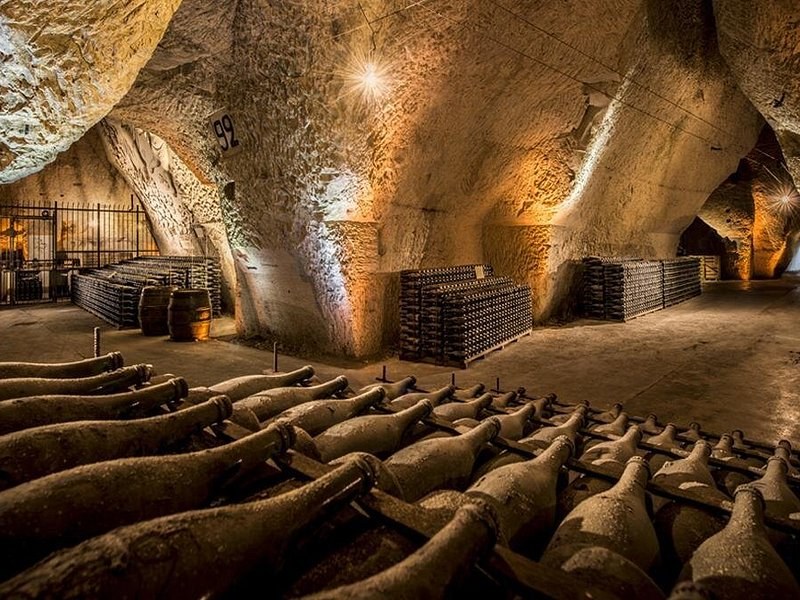
4. 110 km of cellars under 1.5 km of street
The Avenue de Champagne in Épernay runs for about 1.5 km, and about 110 km of cellars lie beneath it. Under Saint-Nicaise hill in Reims there are 25 km more, and nearly 10 km under the historic hillsides. Moët & Chandon alone counts 28 km of cellars, Mumm almost 25 km and Mercier 18 km, 30 m down.
5. Growers outnumber houses forty to one
The Comité counts 16,460 growers and 410 houses. Yet the houses shipped 191.9 million of the 266.1 million bottles sold in 2025, about seven in ten. So most champagne you have ever drunk came from a house, while most of the people making it are growers. The difference is the subject of houses vs growers.
6. Non-vintage waits 15 months; vintage waits three years
Non-vintage champagne must age for at least 15 months before it leaves the cellar, and a vintage for at least three years. Those rows of bottles you walk past on a cellar tour are that rule in stone, and the dates on them tell you how long each one has waited.
7. Brut is not the driest
The word on the label is a measure of sugar per litre, and most visitors never learn the scale:
- Brut Nature, Pas Dosé or Dosage Zéro: under 3 g.
- Extra-Brut: 0 to 6 g.
- Brut: under 12 g.
- Extra-Dry: 12 to 17 g.
- Sec: 17 to 32 g.
- Demi-Sec: 32 to 50 g.
- Doux: over 50 g.
8. Two letters tell you who made it
Look at the small print on the label. RM, récoltant-manipulant, means a grower that makes champagne only from its own grapes. NM, négociant-manipulant, means a house that buys grapes, musts or wines as well. RC means a grower who takes its wine back from a cooperative.
9. Thirty-three kings were crowned in Reims
The cathedral parish lists 33, from Louis the Pious in 816 to Charles X in 1825, with Charles VII in 1429 and Louis XIV in 1654 among them. Reims Cathedral is free to enter and opens daily from 8:00. The Palais du Tau beside it is closed for works until 2027.
10. Champagne is on the World Heritage list twice
UNESCO listed the cathedral, the former abbey of Saint-Remi and the Palais du Tau in 1991. In 2015 it added the Champagne hillsides, houses and cellars: the historic vineyards of Hautvillers, Aÿ and Mareuil-sur-Aÿ, Saint-Nicaise hill in Reims, and the Avenue de Champagne and Fort Chabrol in Épernay. Both are on things to do in Reims and Épernay.
11. The harvest came early in 2026
Picking opens about 90 days after the vines flower, village by village. In 2026 the Comité set the opening dates between 8 and 22 August, so anyone planning a September harvest trip found the grapes already in. When to visit has the dates, and the weather page has the monthly temperatures.
12. The cathedral towers take 249 steps
If you want the view over Reims, you book it: the towers of Reims Cathedral open only on a guided climb of 249 steps, booked online, for EUR 9. Under-18s go free, and so do EU residents aged 18 to 25. You cannot climb from 16 November to 14 February, when the towers close for the winter.
13. One house tours its cellars by train
Mercier, on the Avenue de Champagne in Épernay, has 18 km of cellars 30 m down, and you ride through them on a driverless train. It is also the cheapest big-house visit you can book direct, at EUR 25 for an adult and EUR 12 for 10 to 17-year-olds, and a lift takes wheelchairs down.
14. The United States drinks the most
Of the bottles shipped abroad in 2025, the United States took 26.5 million and the United Kingdom 22.7 million, the first two export markets. Every tour we list is sold in English.
How to use these facts on a tour
You will get more from the glass if you arrive with a few of these in your head. Ask your guide whether the wine in front of you is non-vintage or vintage, and you will know how long it waited. Turn the bottle and find RM or NM, and you will know whether the person pouring grew the grapes. When the guide says "brut", you will know it means under 12 grams of sugar a litre, not the driest there is.
Want to hear the stories behind these figures on the spot? A guide covers most of them between the cellars and the vines, and the champagne houses page lists what each house shows you.
Tours that take you down into the cellars
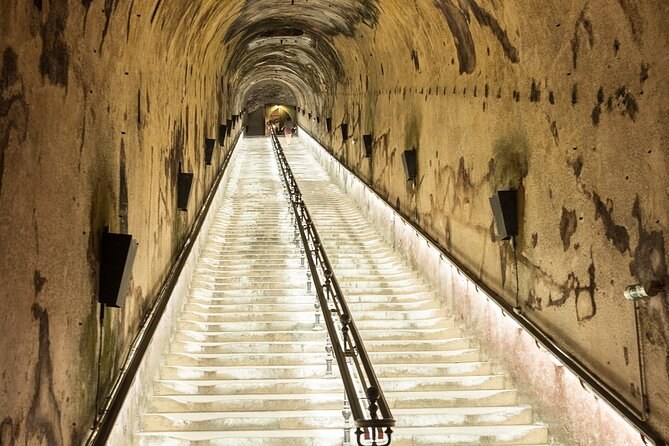
Full Day Champagne Pommery Small Group Tour
Pommery's cellars, Reims Cathedral, Hautvillers and a boutique producer at Cumières, from Reims station or your hotel.
From $291 per person
Check Availability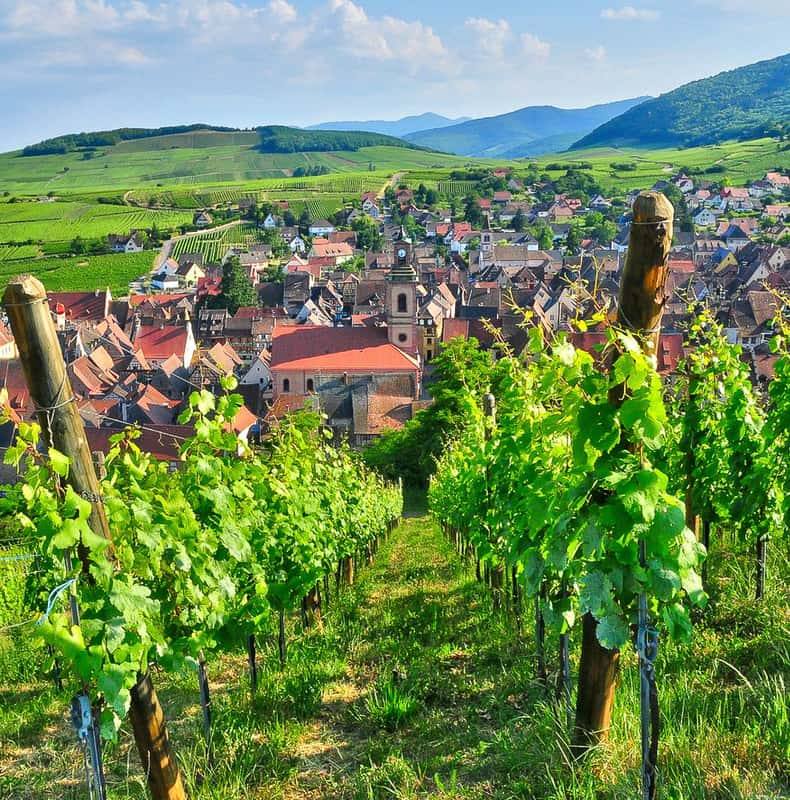
From Paris: Small-Group Champagne Day Trip with Six Tastings
A 7:00 am minibus from Paris to Reims Cathedral, a family winery and Nicolas Feuillatte, six glasses, eight people at most.
From $263 per person
Check AvailabilityNext: Match the facts to the land on the four growing areas. Every fare sits side by side on Champagne France Tours.